Across Canada, local news is disappearing. Between 2008 and 2025, more than 600 local news outlets closed, leaving hundreds of communities without reliable, on-the-ground reporting.
But alongside that loss, something else is happening. New models are emerging, and new partnerships are taking shape.
The Great News Rebuild is a new report from the Public Policy Forum, the Rideau Hall Foundation and the Michener Awards Foundation. It explores what it will take to rebuild local journalism in Canada.
Where philanthropy fits
The report reinforces something the RHF has seen through its work in this space. Philanthropy has an important role to play in the health of the sector, but it is not a permanent solution.
Its greatest value is in helping ideas get started, testing new approaches, and bringing partners together. That convening role is where RHF continues to focus, connecting media leaders, funders, and policymakers to move from conversation to action.
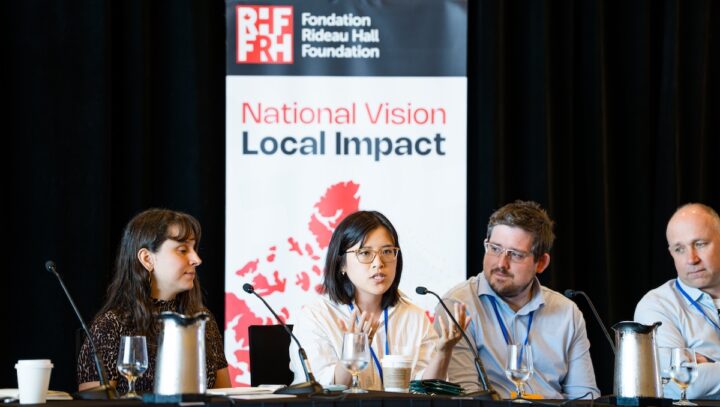
“The philanthropic sector has a critical role to play in supporting and protecting local news,” said Teresa Marques, President and CEO of the Rideau Hall Foundation. “It can help ease the pressure from diminishing ad and subscriber revenues through funding, but can also add capacity, help develop new skills, and support innovation and risk taking that will not only keep these newsrooms alive, but allow them to thrive.”
Long-term sustainability, however, depends on something broader. Local news organizations need diverse revenue streams, stronger ties to their communities, and support from both public and private partners.
Key recommendations for rebuilding local news
The report outlines practical steps to strengthen the sector. Several stand out as immediate opportunities for collective action:
- A national local news accelerator: A dedicated accelerator could provide small outlets with business training, mentorship, and tools to grow sustainably. Many organizations simply do not have the time or capacity to build these systems on their own.
- A shared services model: Pooling back-end functions such as HR, payroll, and editing could reduce costs and allow small newsrooms to focus on journalism. This is an area where collaboration, supported by philanthropy, could unlock real efficiencies.
- Policy changes that reflect reality: Current requirements for federal journalism support do not always match how small or rural outlets operate. Adjusting these rules could help more organizations access support and grow.
- Simpler access to government funding: The system is fragmented and time-consuming. A “one-window” approach would make it easier for organizations to access the support that already exists.
- A stronger, unified voice: The sector itself must better communicate its value, to funders, policymakers, and the public. Local journalism is not only an industry but a public good – essential to informed communities and a healthy democracy.
A three-part look at local news in Canada
The Great News Rebuild builds on earlier work led by the Public Policy Forum, the Rideau Hall Foundation and the Michener Awards Foundation. Together, The Lost Estate, Uncovered, and The Great News Rebuild form a three-part series examining the decline of local news, its impact on democracy, and the path forward.
The Lost Estate outlined the scale of local news loss across Canada. Uncovered explored what that loss means for democratic participation, particularly during elections. Now, The Great News Rebuild focuses on solutions, highlighting what is working and where collective action is needed next.
A shared responsibility
There is no single fix. Rebuilding local news will take a coordinated effort across philanthropy, government, media, and communities. For the RHF, this means continuing to bring people together, support new ideas, and help build the conditions for long-term sustainability.
Local journalism plays a critical role in how communities stay informed, connected, and engaged. Strengthening it is work that belongs to all of us.